
Body-leash sleep monitoring
A tool we invented to catch movement at night without staying awake for it. It is a household trick, not a treatment, and I want to be clear about that.
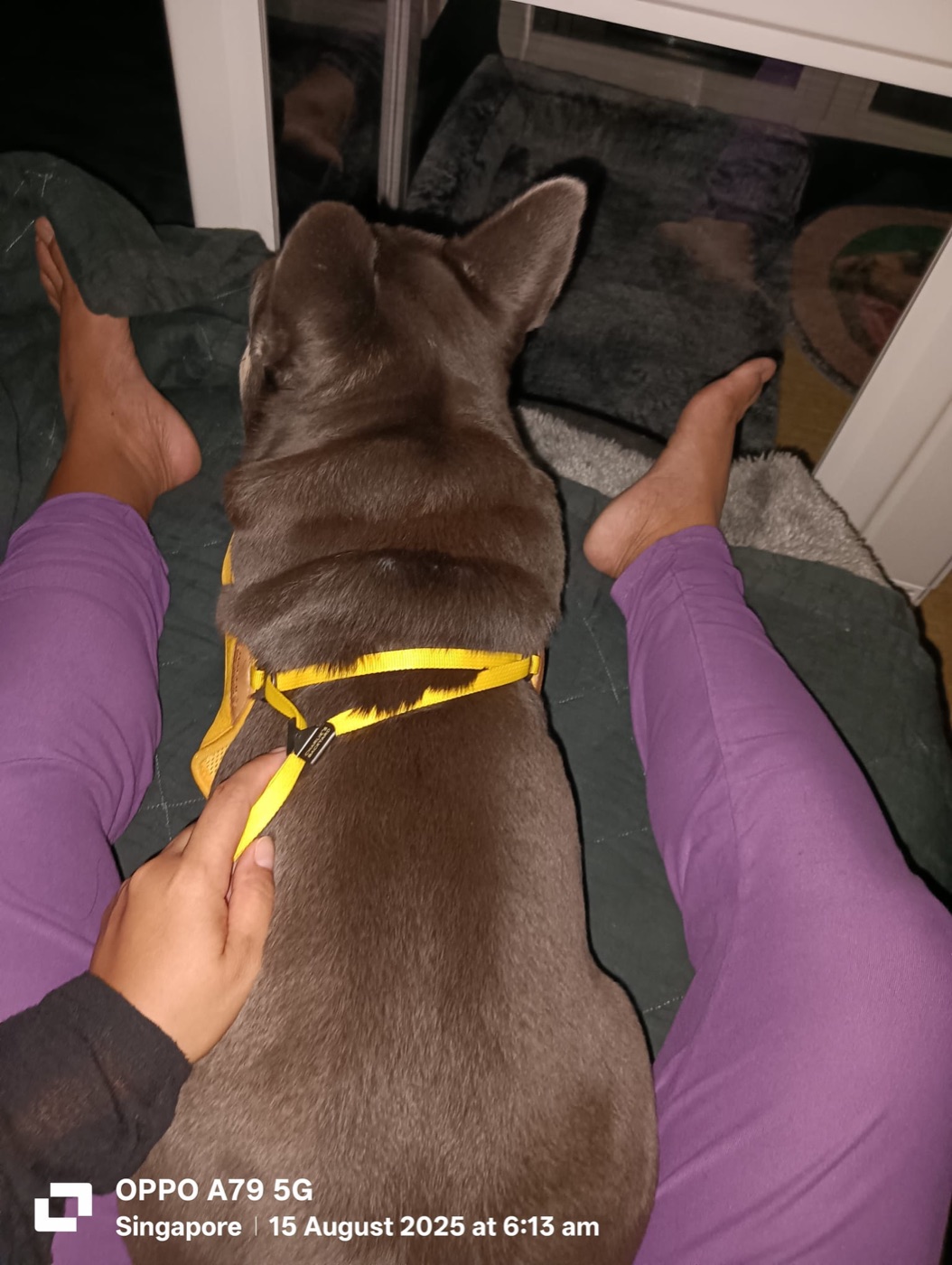
Making the dog the alarm
The problem with night was simple: a dog who is not supposed to move can move the moment you fall asleep. So we tied a leash. A body leash on me, a regular leash on Babi when he was allowed up on the sofa or the bed, so that any movement of his transmitted straight to me. He became the alarm. The smallest shift woke me before he could do anything that mattered.
For the nights he slept alone in the playpen, a Tapo pet camera with night vision did the same job from across the room. Between the leash and the camera, we could actually sleep, and still catch the movement we were terrified of.
What I came to understand is that the leash was not a treatment. It was a way to keep the rest intact, and the rest is what the guidelines back. The trick was ours.
What the guidelines back
To be straight with you: there is no study on “body-leash sleep monitoring.” We made it up. I am not going to dress a household trick up as medicine.
What the guidelines back is the thing the leash and the camera were protecting: at least four weeks of restricted activity, with no jumping on or off furniture and no stairs. (ACVIM 2022 consensus) The evidence behind that advice is low-level, and no study ties relapse to one jump. The tools themselves are unstudied.
How long your dog needs strict rest, and how confined, is your vet's call. The leash and the camera are just ways to hold the line they set; use whatever lets you keep your dog still and still get some sleep.
Sources: restricted activity as the core of conservative management, ACVIM 2022 consensus, which rates the evidence behind it as low-level (per the conservative-management research). The body-leash technique and the Tapo camera, Babi & Juju records.