
On the way to the vet
You called the vet. You're on the way, or you're waiting for them to call back. The action is in motion. This page is for the next few minutes. You don't have to remember any of it.
What you might be looking at
Your dog can't tell you it hurts. So the body tells you in three ways at once:
- Your dog yelps when anything pulls on a painful spot.
- They hold the neck or back still to stop it pulling.
- They tremble because the pain is constant and the nervous system keeps firing.
What I came to understand is that this combination, the yelp plus the held posture plus the tremor, is the textbook presentation of intervertebral disc disease. A disc in the spine has shifted enough to press on the spinal cord or on a nerve root. Heavy panting fits the same pattern; dogs offload pain through panting when they cannot move away from it. It is not always heat. It is not always anxiety.
What it is not: a behavioural problem, a passing strain, or something you caused. It is a disc that has been quietly weakening for months or years, and just crossed a line.
Sources: Hansen 1952; Brisson 2010 review. Panting as a pain sign: Cornell Riney Canine Health Center; WSAVA 2022 pain guidelines.
Why your dog specifically
Rate of epidural haemorrhage at disc rupture, by breed.
French Bulldogs are not bad luck cases. The breed carries a gene called FGF4 on chromosome 12, an extra accidental copy of a growth gene, that turns soft disc tissue into brittle cartilage before the dog is even a year old. By the time a Frenchie is three or four, the discs are already at risk of catastrophic rupture.
When the disc does rupture, French Bulldogs are about four times more likely than Dachshunds to also have epidural haemorrhage at the rupture site. The published rate is 41.3% in French Bulldogs versus 11.2% in Dachshunds. The haemorrhage worsens prognosis even when the initial grade looks the same. This is not your dog's fault, and it is not yours. It is a genetic instruction written into every cell, from birth.
Sources: Brown et al. 2017, PNAS; Poli et al. 2022, J Vet Med Sci; Murphy et al. 2019, Vet Pathol.
What the vet will likely look for
The vet's first job is a neurological exam. They will check whether your dog can walk, whether they can feel their feet, whether they have bladder control, whether they yelp when specific spots are pressed. The exam takes a few minutes and is mostly hands-on. A lot of the diagnosis happens before they touch anything.
After the exam, they assign a grade from 1 to 5, on a scale neurologists use to classify how far the disc problem has progressed:
- Grade 1Pain only. No weakness, no problems walking.
- Grade 2Walking but unsteady. Some weakness in the legs.
- Grade 3Cannot walk. Movement reduced but sensation intact.
- Grade 4Paralysed in the back legs but can still feel pain.
- Grade 5Paralysed and cannot feel deep pain. The most serious presentation.
The grade matters because it determines what the vet will recommend next: medication and rest (often grades 1 and 2), or imaging and consideration of surgery (often grades 3 and above). The earlier you arrived, the better positioned the vet is to make this call.
Sources: Modified Frankel scale, standard veterinary neurology grading.
What we did when this happened to us
In June 2025, in Singapore, one of our two French Bulldogs, Juju, crawled under the sofa during play and didn't come back out the same. She went quiet but kept eating. We thought it would pass.
Then at 3 AM on 11 June, she started to pant. Heavy. The kind of panting that doesn't fit the temperature, doesn't fit the hour.
Frenchies pant. They pant in cars, after walks, for no reason in the middle of the afternoon. You learn the difference between a heat pant and a wrong pant. This was a wrong pant.
We booked a ride to Advanced Vetcare, our regular clinic. You don't drive at 3 AM with a panting Frenchie if you don't have to; you want both hands free for her, and someone else watching the road. The vet on shift gave her a pain injection. Within minutes she slowed. Within twenty minutes she was asleep. They sent us home with gabapentin to start that morning.
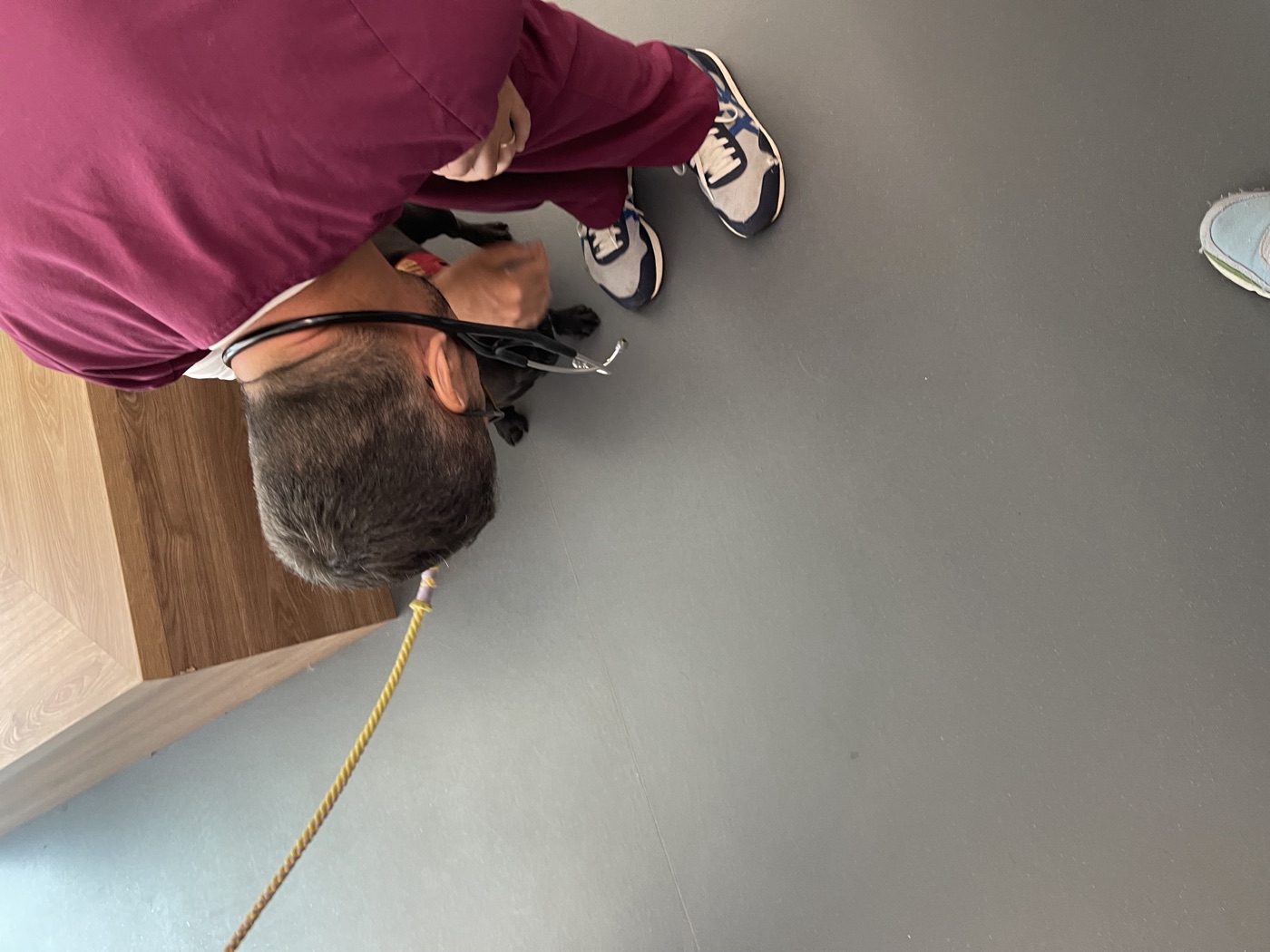
We took the ride back. She slept next to us in the bed, the room dark, and for the rest of that night I let myself believe whatever it was had been handled.
Then I touched her neck.
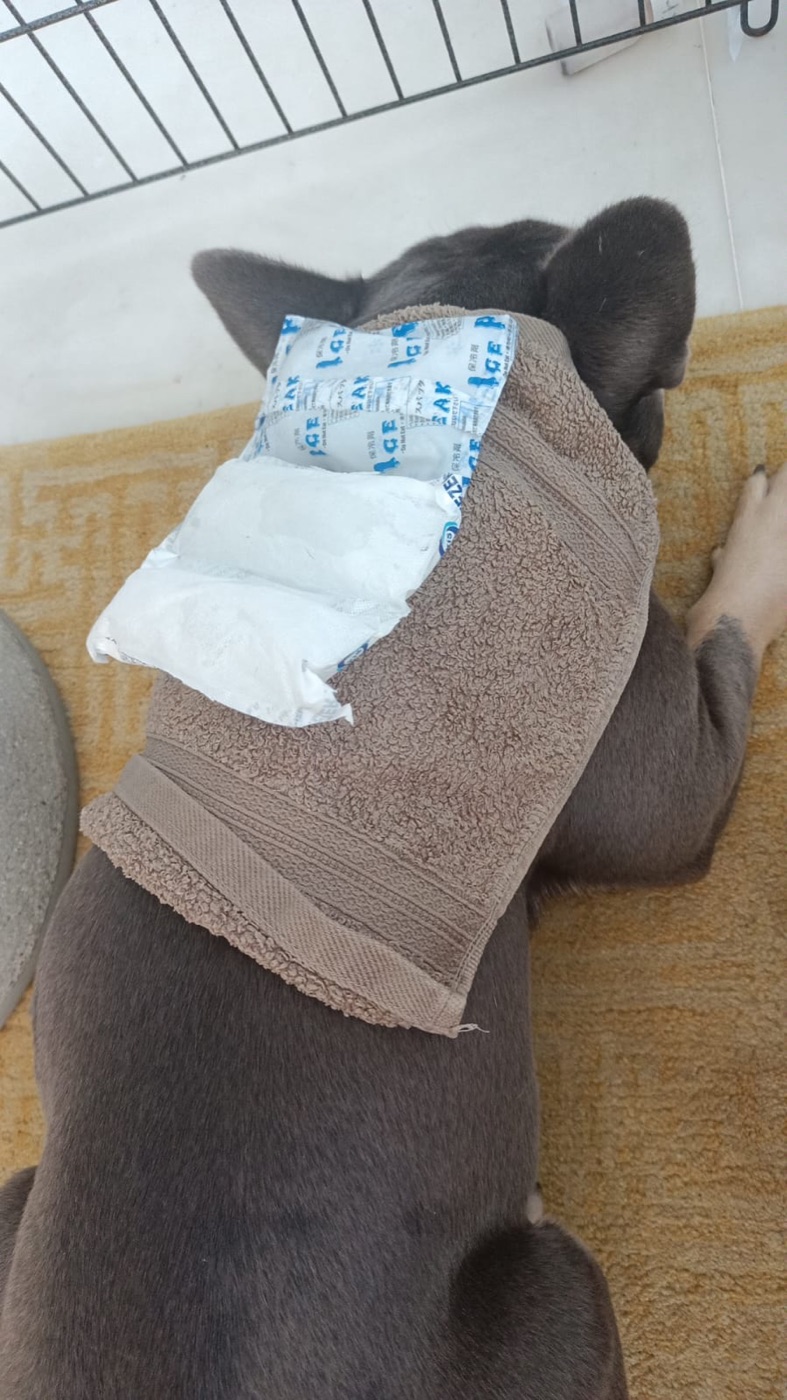
She yelped, short and sharp and involuntary. Not a sound she had ever made before. She held her head tilted to one side and kept it there, stiff, the way you would hold yours if you had slept wrong. She trembled. The trembling did not stop.
Two weeks later, our other Frenchie, Babi, went down too. Different night, different vet, same three signs: the yelp, the held head, the tremble. We had this conversation twice in one June.
What we wish we'd known about how to read what's happening on the way
A few things to watch for in the next few minutes:
- A change in the level of panting. Heavier can mean the pain is escalating; quieter can mean it's receding or the dog is exhausted.
- A change in the held posture. If the head was tilted and is now straight, that can be improvement or fatigue; mention either to the vet.
- A leg that was working and is now not, or a leg that was still and is now twitching. Both are signs the situation is moving.
- Sudden silence, sudden stiffening, sudden loss of bladder control. These are signs of acute progression. Tell the vet on arrival.
When you get there, tell the vet what changed in the last hour. They will already be looking for it. If you have video on your phone of what your dog is doing right now, take it; it helps.