
Seven-day meal prep
The Sunday batch we fed them through recovery and after, and an honest read on what the diet evidence supports. The weight loss is the part that's actually backed.
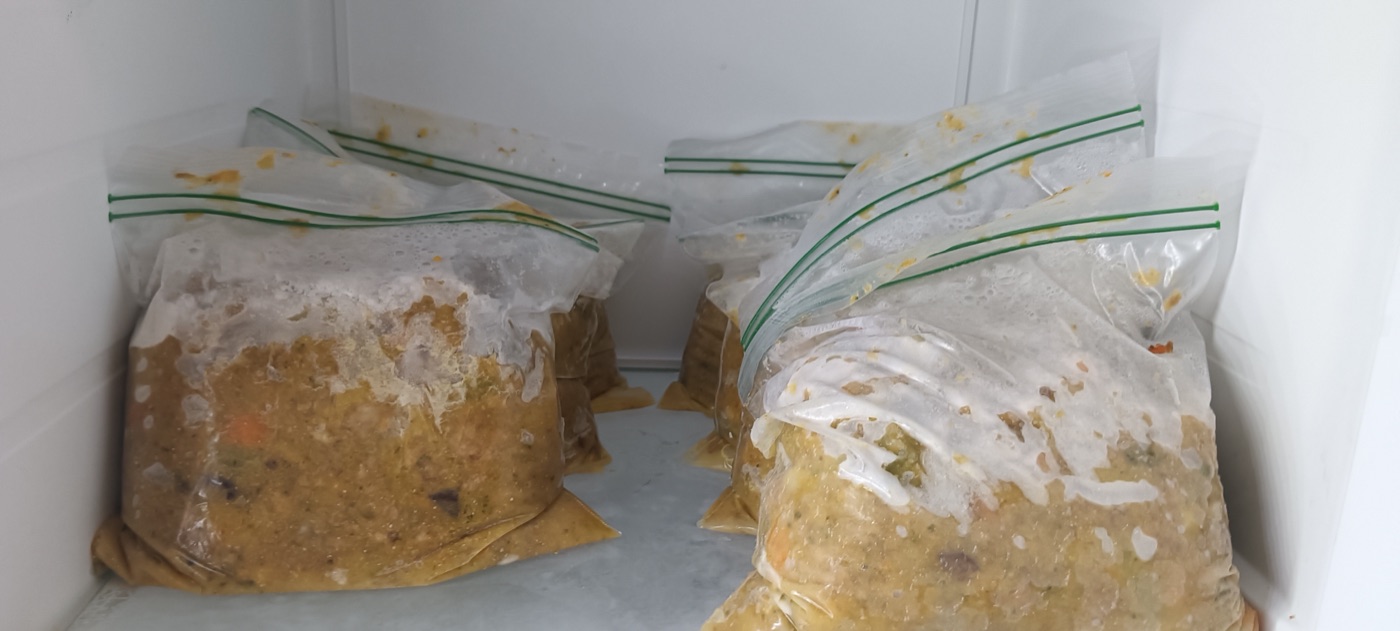
The Sunday batch
We took them off dry kibble entirely and moved to a homemade batch, cooked every Sunday from a recipe I kept and refined. Babi got larger portions, Juju smaller, fed twice a day.
- Bone broth
- Pork mince
- Pork kidney and liver
- Sweet potato
- Broccoli
- Eggs and eggshell powder
- Olive oil
- Turmeric paste
- Sardines
- Multivitamin (Rx Essentials)
- Joint capsule (Antinol, PCSO-524)
- Vitamin D3 drops
- Zinc picolinate (Babi only, alternate days)
The most striking result was not on a scan. Over about ten months on the maintenance version of this food, Juju went from 14.5 kg at the peak of her episode to 10.2 kg, roughly a thirty percent loss.
What I came to understand is that the food was the one lever we fully controlled, but the weight loss, not the boutique ingredients, was the part the evidence actually backs. I wanted the broth and the turmeric to be medicine. They were not. The lighter dog was.
What's backed, and what isn't
The honest headline first: no controlled trial has shown that anti-inflammatory diets or nutraceuticals treat IVDD. Most of the ingredients people reach for are extrapolated from joint-disease research, not disc disease. (conservative-management research, §6)
- Omega-3 (the sardines, fish oil): moderate evidence in osteoarthritis; the jump to IVDD is unsupported. (Roush et al. 2010)
- Turmeric / curcumin: poorly absorbed, joint-disease evidence only, no IVDD evidence. (Comblain et al. 2017)
- Eggshell calcium: human and pig data only, no canine evidence. We fed it; I would not claim it did anything. (conservative-management research, §6)
- Weight, the strong one: obesity is a repeatedly-observed IVDD risk factor, and weight is the single highest-leverage thing you can actually change. For a Frenchie, a lighter dog also breathes better in the heat. (Packer et al. 2013)
The safety caveat that matters most: in one analysis, ninety-five percent of home-prepared dog recipes were short on at least one essential nutrient. A homemade diet should be checked by a board-certified veterinary nutritionist before it becomes the only thing your dog eats. (Stockman et al. 2013)
This is what we fed, not a formulated recipe for your dog. Before you move a dog onto home-prepared food long-term, have the recipe reviewed by a board-certified veterinary nutritionist, and let your vet steer the weight target.
Sources: no IVDD diet trials, omega-3, turmeric, and eggshell calcium, conservative-management research §6 (Roush et al. 2010; Comblain et al. 2017); weight as risk factor, Packer et al. 2013; home-prep nutrient deficiency, Stockman et al. 2013. The recipe, add-ons, and Juju's weight loss, Babi & Juju records.